

Our Buglas Bamboo tour de force ended with a visit to their furniture showroom. Locals of the bamboo industry were present to speak to the group which eventually lead to our summing up of our influential 2-day stay in Dumaguete. The afternoon meeting concluded with team Nagaland singing a lovely song in appreciation of Frans and crew. Before taking off for our hotel, Frans was kind enough to take the time to speak with us for a special interview. You can view the insightful interviews with Frans here.
Sunday, October 7, 2007

Bamboo Immersion Trip - Day 2

After visiting Buglas Bamboo's factory we visited their pre-processing factory located only 15 minutes away. All the bamboo that is harvested for building is brought here for proper treatment and drying to resist bamboo-damaging fungi and insects.

Bamboo Immersion Trip - Day 2

Borax bath anyone? This vertical acidic bath process helps preserve the bamboo by making it resistant to fungi. The diluted borax water mixture is reused many times over. We are still researching its application and environmental impact as it has a history of benefits as well as toxicity implications to humans in concentrated doses. Natural anti-fungi properties exist in various vegetation here in the Philippines such as in coconut oil as well as lemon grass though it is not commercially used. These non-toxic alternatives could make for an excellent solution as well as fuel sustainable local industry. We will be conducting testing to see if this can be a viable solution.
Even though borax is commonly used throughout the year, the process only needs to be used on bamboo harvested during the wetter months. During a certain time of year (we were told the months here ending in - er) all harvested bamboo is naturally fungi resistant. Another alternative to borax could be the integration of larger and more abundant bamboo plantation resources. This could make it possible to entirely eliminate this processing stage and facility. All the more reason the world needs more bamboo plantations.
Bamboo Immersion Trip - Day 2

The harvesting and processing of bamboo creates stable and steady work for both men and women. Buglas Institute's continued support of the community makes his company a shining example and model for developing economies around the world. The industrial quest for more advance and expensive machinery is not always what is needed especially in these economy building societies. Here in the Philippines it is clear how industries creating viable jobs can create the most positive change.

Bamboo Immersion Trip - Day 2

Group photo taken at Buglas Bamboo Insitute's factory. This afternoon marked a significant point in our research and made our decision to join the tour unmistakable. Our confidence is greater than ever and now we have a clearer vision of how this will affect the design of our bamboo home for the Winaca Village.
Bamboo Immersion Trip - Day 2

Preparation process in the making of flat bamboo sheets for flooring and walls.
1.) split bamboo in two halves, 2.) continue to split the bamboo culm from within taking care in not chopping all the way through, 3.) once bamboo is more or less flat, remove inner nodes, 4.) plane until both surfaces are smooth and to desired thickness, 5.) glue laminate, fill panels and let dry in preparation for final planing, 6.) repeat.
Video can be seen here.

Bamboo Immersion Trip - Day 2

Other than power tools, these are the most common tools used by workers at Buglas Bamboo. This shows to tell how simple bamboo can be to work with, but as we have observed, demanding of craftsmanship, skill and experience. The larger blade is used to split and flatten bamboo, cutting inner nodes, and making rough cuts. The smaller blade is used for finer carving and working out details and fittings.
Bamboo 101

Bamboo, or the family Poaceae, subfamily Bambusoideae, tribe Bambuseae (for you biology particulars out there) is a wood perennial evergreen, and is a true grass. There are over a 1,250 species most growing within 40 degrees of either side of the equator. Here in the PI, there are 62 species, 21 of which are endemic or native. The applications are diverse, ranging from fabric, paper, food, charcoal, and exemplary design materials. We are now in an exciting time of increasing technological advances where we will probably see sustainable bamboo replace slow-growing solid wood as the new residential building material. An interesting fact is that a 60 foot tree cut for market takes 60 years to replace. A 60 foot bamboo cut for market takes 59 days to replace. These facts come courtesy of the informative website for the International Network for Bamboo and Rattan (INBAR). Link located on side bar.
// Cons
Susceptible to fungi and insects
Misconceptions as poor man's lumber
Still figuring it out...
// Pros
Appealing aesthetic
Tensile strength
Extraordinary hardness
Renewable + sustainable
Abundance and rate of regeneration
Quick to reach harvest maturity: +3 yrs.
Easy propagation
Not clearcut during harvest unlike wood
Plantations remain green + O2 producing
Diverse range of possible applications
Bamboo Immersion Trip - Day 2

Our day started off with a comprehensive tour of Buglas Bamboo Institute's factory located on the outskirts of Dumaguete. There, several projects were in the making, including a bamboo home that was being built for disassembly to be shipped out to a client in Belgium. Several furniture pieces were also being worked on, as well as bamboo slats and sheets for flooring and wall applications. Observing the workers in this open-air, well-equipped warehouse gave us a first-hand look at how bamboo is worked and used as a building material.
Video can be seen here.Saturday, October 6, 2007
Bamboo Immersion Trip - Day 1

After checking into our hotel in Dumaguete, we visited Our Lady's Garden, a beautifully landscaped paradise set on top of a hill. Several bamboo structures which were built by Buglas Bamboo added to its serene ambiance.


Bamboo Immersion Trip - Day 1

After experiencing the chaos of Manila's regional airport we were more than ready take off for a new island and city approximately one hour south of Manila. Dumaguete (a port city of approximately 100,000) is located in the province of Oriental Negros in the central Visayan region of the PI and is nicknamed "The City of Gentle People". We experienced some of the worst turbulence ever prior to landing but once we arrived in Dumaguete our excitement was back up again. We were greeted by our gracious host, Frans Kleine Koerkamp, member of the Philippine Bamboo Foundation Board of Trustees and chairman of the board of Buglas Bamboo Institute, Inc. Driving to our hotel we instantly had great vibes about the city, especially as it is less polluted than most places we've experienced thus far, and everyone seemed to be smiling!
Bamboo Immersion Trip - Day 1

This morning we visited the Cottage Industry Technology Center (CITC) in Marikina City where we attended a bamboo-filled presentation. We then visited CITC's showroom and toured their well-equipped workshop.
The CITC:
1.) creates a critical mass of producers, production site in strategic locations where materials are abundant and skilled workers are available, 2.) creates employment at the grassroots level for additional income to the farmers, 3.) support the demand of bamboo products locally and when it is exported as they are equipped with the appropriate tools and equipment, 4.) develop and upgrade the skills of craftsmen in the area in order to increase productivity through technology transfer, 5.) link the producers with the local exporters so that they may act as the bridge between the maker and the bamboo processing bases, 6.) provide programs and services for learning how to make footwear and leather goods, fine & costume jewelry, gift wares & holiday decor, and furniture & builders woodwork made out of both bamboo and metal.
After visiting CITC we made a quick stop on our way to the airport to Budji Living, a furniture showroom featuring many pieces from our current favorite Filipino furniture designer, Kenneth Cobonpue, who is also a significant player in the design collective Movement 8.
Friday, October 5, 2007
Bamboo Immersion Trip - Day 0

Fatima Tangan, a bamboo expert who works for the Department of Natural Resources and Environment in Baguio City, opened up a window that has greatly impacted and influenced our vision of the Winaca project, as well as our lives. It all started after a short meeting with Fatima and a brief bamboo tour at the DENR. There, we were invited by Carmelita Berselona (aka Mely), a friend of Fatima and board member of the International Network for Bamboo and Rattan, to join her and a bamboo team of eight from Nagaland, India for an immersion program tour in bamboo production and processing around the Philippines. At that moment we knew that our instincts had to be followed. The group was leaving for Manila the same night so we quickly went home to pack. We were so elated by it all as it was last minute and had hardly any time to advise anyone of the special opportunity. Nevertheless, within an hour and a half we were on the road in a packed van en route to Manila with team Nagaland.
After experiencing one of the scariest rides of our lives down the mountain from Baguio (the driver must of thought he was in a race because he was passing vehicles in front of us on a dark two-way road with incoming traffic literally meters ahead of us, and not to mention with the rain and flooding), we finally made it to our hotel in Manila exhausted but safe.
Thursday, October 4, 2007
Repurpose

These bald tires are getting a new life of comfort off the streets. This chair was found outside a home while touring Asin road, a well known spot filled with wood carving shops near Baguio. I wonder if this designer knows about eco-design or is just putting his talents to use with another available material. Either way, his or her work is brilliant.
Friday, September 28, 2007
Woven Fiber "Sketches"
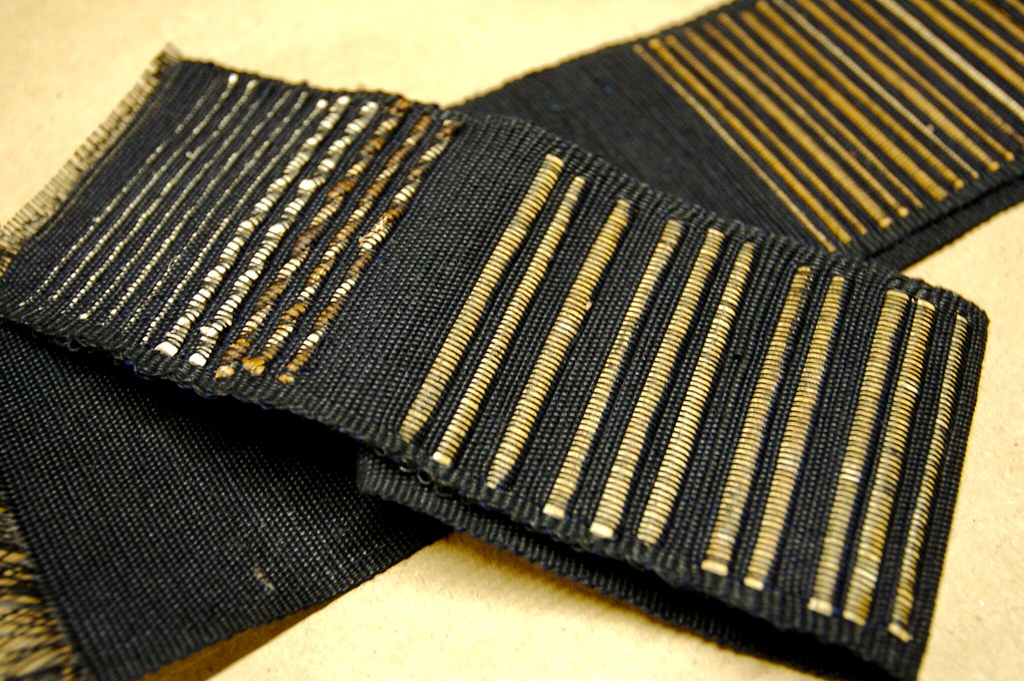
Delores has worked as a loomer for Narda's since 1983. Here, she looms for us a 3-inch wide fabric sample composed of waxed cotton (the warp = vertical thread) woven-in with an assortment of natural fibers , abaca strips, and several plies of cotton (the weft = horizontal thread) for a soft-product side project.
Wednesday, September 26, 2007
Star Search

We are constantly taken back by the talented tradesman and women here in the Philippines. Local graphic signs aren't cut from vinyl, instead they are hand-painted, and seen everywhere the eye meets; shops, bars, restaurants, posters, and even on jeepneys and cars. The weavers are out of this world, with fabric, bamboo and abaca basket style weaving. We are meeting with one such weaver today to have a custom piece weaved for a wallet that we're making. In collaboration with new designs we hope to learn a fraction of what is truly an indigenous skill to the Cordillera and many other island regions.
The skilled work doesn't stop there, it spills over to the carvers as well. We were amazed by the intricate detail and movable parts as is the case with this highly technical tripod design. It is entirely carved out of a single piece of wood - no glue here. This piece, native to the Ifugao region, serves as both sculptural and functional. Its various sizes allow it to become a bowl holder, table base or, with the addition of a leather cover, becomes a seat.

Tuesday, September 25, 2007
Bontoc Home Of Sagada

The Winaca Eco-Cultural Village, so far, features three authentic Cordilleran homes. Six more distinct homes from the region are planned to be re-located to the village. With this Sagada style Bontoc home, there are no windows, only a front door and a back door. The home "suggests a womb--dark, warm and enfolding, both a habitation and a passage". Inside, the interiors are a sooty-black due to a constantly lit fire used to warm the house as well as preserve it. The dimensions are small and are meant to house no more than three occupants, usually only the husband, wife and the smallest child, and just under the roof is the space used as a granary. The Bontoc structure is constructed out of pine and nara woods, which are distinct to the mountainous region of Benguet. One must take note that in other provinces dim, windowless homes contrast drastically in comparison to the bahay kubo of Panay: well-lighted, airy homes that include spaces which convey both an indoor/outdoor sense of space. The village component we will design models that of the bahay kubo in a contemporary way. More details on that later.
Monday, September 24, 2007
Narda's Furniture Warehouse

Entering this warehouse we were surprised to find only two furniture makers. In a space this enormous and filled with a considerable amount of local wood just gathering dust, an environment like this is a designers' dream! We were told that in the 80's the Capuyans had more than 20 furniture makers working full-time to furnish an entire 5-star hotel being built here in Baguio. Since then, the 1990 Luzon earthquake (7.8 magnitude, 1000-plus deaths) and the band on logging in Benguet, the warehouse has significantly cut back on its furniture production, limiting it only to custom orders. The main drawback of the warehouse is its lack of power tools to cut and finish the material. This makes sense as their furniture-making style is quite un-processed: raw organic slabs of beautiful hardwood-rustic, unique and full of character. We hope to make use of the warehouse to the best of our capability and limited access to tools.
Sunday, September 23, 2007
Dr. David Baradas

We finally met with the legend that is, Dr. David Baradas. Within the very first minute of meeting him he became our close mentor, resource, and friend. How alive this man is. Any explanation of him would not do him any justice. After our 17-hour meeting with David, filled with conversations that spanned the spectrum from Filipino design to his adventures around the world, our a multi-destination tour of Baguio left us utterly inspired, connected and more aware of the Winaca project and life in general.
Wednesday, September 19, 2007
Baguio Arrival

Baguio - Panoramic, originally uploaded by jsigharas.
We arrived to Baguio's bus depot at 7 am. The bus ride was bumpy, and therefore left me in a half-asleep/half-awake state for the entire trip. I'm absolutely exhausted and jaded from big city life and looking forward to some peaceful times in the mountainous region of Benguet. Baguio City (pop. 250,000 plus) is at an altitude of approximately 1500 meters (5100 ft) and set in a moist tropical pine forest. The terrain is diverse and hilly and reminds me a little of where I grew up in Asheville, NC, except dryer and more polluted. The environment is so different from what I'm accustomed to in the Philippines as it is known more for its tropical island/beach climate. It also is significantly cooler here compared to muggy Manila. From what I've seen it seems like you can catch an amazing view from almost any point.
Alex and I will be staying in the municipality of La Trinidad, on top of Narda's weaving factory. Our pad is great. It's basically the size of a small apartment with 1 master and 1 guest bedroom. We just finished touring the weaving factory that's below us and met with Narda and Wilson Capuyan, directors of the Winaca Foundation. Great conversation and inspiring ideas have left us antsy. Stay tuned!

Subscribe to:
Posts (Atom)