
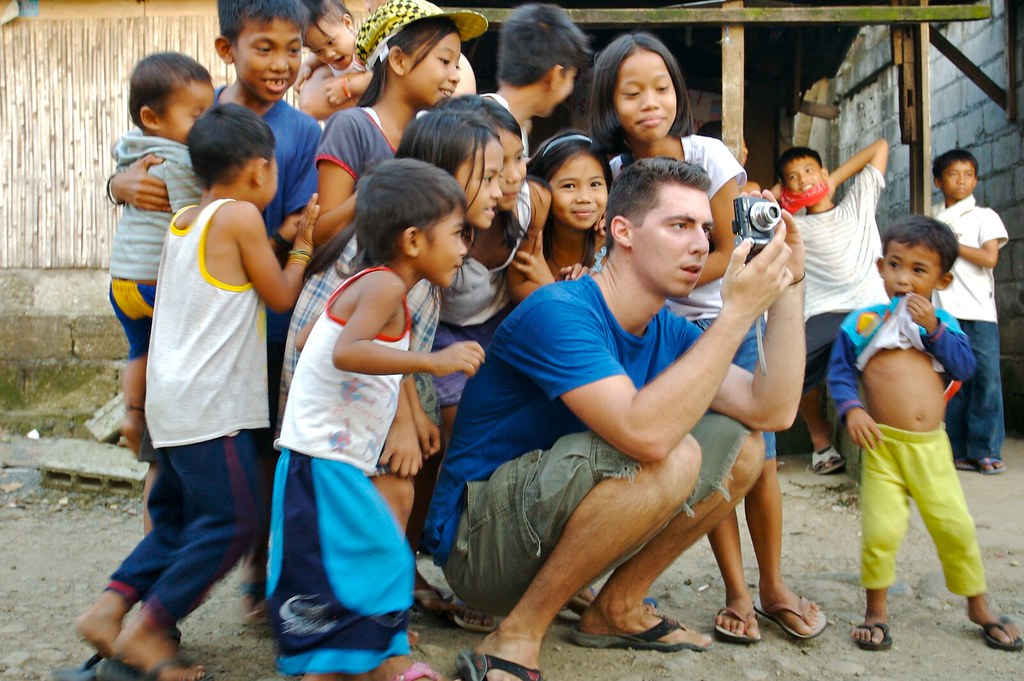
Payatas dumpsite is one of the largest landfills and poorest areas of metro Manila where many families make a living by scavenging and recycling from tons and tons of garbage. Alex and I decided to check out the dumpsite to get a good glimpse of the action, but unfortunately, we had to have a letter stating our purpose. So instead, we wandered the surrounding neighborhoods on our own. There, we encountered some of the poorest yet most caring, loving people truly living a simple life. The fun and adorable children were so great to us. They made it a heartfelt afternoon I will never forget. Looking at the pictures of that single afternoon always makes me smile. We plan to return soon to give them the photos we took of them.
Tuesday, October 16, 2007
Exploring Payatas



Occupation - Recycler

Payatas Dump - Plastic Recycler, originally uploaded by suvajack.
Scattered around the dump you can find many spots focusing on recycling a particular garbaged commodity. Here, this girl sorts through different types of plastic. It's a strange place filled with recyclers working in a place filled with buildings that both resemble and function as a business and home.

This man takes sorted garbage and soaks and washes the plastic. It's a long, hard day to earn is few dollars. Sorting, sifting, sorting, sifting.

Amazing how one man's waste is another man's meal ticket.
Saturday, October 13, 2007
A Modern Filipino Home

We were grateful to visit the home of Mausen and Davig Ong with MM, an artist whom we first met at an art opening at Mo_space Gallery, to have dinner and spend the evening with them and conversing over wine and lounge music. Their home is seamlessly perched on the edge of a plateau that overlooks northeastern Manila's - offering panoramic views galore. Their "open" home features a three-story porch constructed out of aged timber that was saved from old houses intended for demolition. At first sight it looks like an oversized gazebo. The structure blends perfectly with it's surrounding, lush, tropical gardens allowing nature to become part of the wooden abode. Benjie Reyes, a Filipino artist, designed their home in a distinctly modern architectural style. Discreet from the outside, one cannot fully appreciate it's entire ambiance until you enter. We instantly felt the warmness of the home with it's interior done in beautiful dark wood that displays Benjie's mastery of the medium. The interior decor is composed of a mixture of antiques, traditional crafts, and works by contemporary Filipino artists. Mausen and David's home is a beautiful example of a modern Filipino home, and the evening inspired us in many ways.

Fort Bonifacio Global City

Fort Bonifacio is an urban development in Taguig City, Metro Manila. Originally known as Fort McKinley, it was a property acquired by the U.S. government during the American colonial period. Today it is the home to upscale residential condominiums, trendy restaurants, bars, clubs, and many retail outlets.
We frequent this shopping center quite a bit as there is a great book store called Fully Booked (they have a great selection of architecture and design books), free internet at Starbucks, expensive but good food, a few galleries (Mo_Space is one), and a few high-end furniture stores (Bo Concept, Natruzzi and the soon to be open Vitra, which we got a special sneak preview of with the owner, Mausen Ong).

Back In Manila

After a week touring bamboo hot spots in the Visayas, we met with Mely, our bamboo trip coordinator, at what seemed like an unoccupied, empty mansion in Manila. Mely uses a single room of the residence as an office away from her home-base in Abra. The most spacious room of the home displays a number of furniture prototypes (mostly chairs) made by a few designers working for her. Their furniture is mostly constructed out of bamboo, using plywood-bending and molding techniques to create their forms. It's great to see them experiment with bamboo furniture in a modern approach, but they use a lot of toxic resins and lacquers, which we look down upon. Unfortunately, we are not able to post any photos of the furniture as they are still prototypes, but we did find this beautifully woven suitcase among a shelf of other fine bamboo products.
Friday, October 12, 2007
Argao - Skimboarding Capital Of The Philippines
There seems to be talent here in the Philippines everywhere we go and Argao was no exception. We met these boys the night before trying to find lodging; their dad's beach cabin didn't quite work out but our plans to meet up for some skimming the next day did. Turns out these kids are some of Argao's finest when it comes to skimboarding and surfing. They said the surf gets really good when a typhoon rolls into town. We didn't want to wait around for that but we did enjoy a little fun in the sun. Check the footage. Also check out Argao's Mahayhay Beach and the boys' on a big day in this YouTube video.
Argao - Skimboarding Capital of the Philippines
We took a day off from our intense, non-stop traveling to relax and hit the beach for some sun and swimming in Argao, a small town an hour south of Cebu. Turned out that Argao was absolutely dead (which was good and bad). Fortunately, we met these local skimboarders of Mahayhay Beach, a well-known spot for skimboarding, and took our turns skimming the beach shores (or in my case, attempting to learn in not the easiest of conditions). I figured if I could learn here I could it pick it up elsewhere easily. Anyway, these young guns were busting out moves effortlessly, making it an entertaining afternoon in the sun and splash. I guess that's the product of having miles of beautiful beaches and nothing else to do.

Thursday, October 11, 2007
What Makes Good Furniture?

Design? Function? Cost? Materials? How it matches your decor? What it does to your indoor air quality? I think all of these things are important. The problem is the latter is nearly never an issue for the average buyer, not unless your child has serious allergies and can be immediately affected by the off-gases that only slowly poison the rest of us.
Some of the factories we visited on our Cebu trip, which I won't mention, made the both of us feel like our heads were in a vice grip from all the fumes. We hope these companies will find a non-toxic alternative for both their workers and end-clients. In just a few clicks I found these solutions on the net, Aquaresin and Bioresin. I'll be sure to pass it on. It's our job as consumers and healthy beings to request and expect only ecologically and health friendly products and materials as the only option. Hopefully one day furniture stores and building supply shops will only be allowed to carry non-toxic products. That way everyone can afford a healthy home and we can return to thoughtless shopping. Until then, be eco and health conscious.
Here is a great site and a one stop shop to start getting the info you need to go green.
Bamboo Immersion Trip - Day 6

Accessoria Inc. is a company founded by Lorelei Rodriquez and Luisa Robinson, an active member of Movement 8. They are known worldwide for their mastery and innovation in the use of snake skin, leather, stone, vine, tobacco leaves, shells, and other indigenous materials for home decor furnishings. We visited their showroom/factory outside of Cebu City which housed a small, yet impressive collection of items. Their attention to color, form and texture truly reflect the land and resources found on the islands which easily appeal to an international audience with modern, organic tastes.
Wednesday, October 10, 2007
Bamboo Immersion Trip - Day 5

We arrive in Cebu excited to see what this metropolitan area of 3.5 million-plus has to offer. Cebu is one of the most developed provinces in the country and the main center of commerce, trade, education and industry in the central and southern parts of the archipelago. The tropical island attracts international attention for its white sand beaches, world-class golf courses, casinos, and in our case, furniture designers. Cebu is the largest exporter of furniture in the Philippines and home to hundreds of furniture factories (the majority of them are foreign based).
Another product Cebu is known for is its guitar. We visited Alegre Guitars in Lapu-Lapu City to check out their factory and showroom to see some examples of their finely crafted, handmade guitars.

Bamboo Immersion Trip - Day 5

These houses on the sea are the traditional dwellings of some of the old local tribes. Most coastal tribes made there livings on the water; some would either sleep on their boats or opted for more stable accommodations on water houses such as these. The simple dwellings are constructed a little like that of a nipa hut but serves a much different purpose as of a place out of the sun to rest and attach a boat while drying out the catch of the day. This particular house is constructed in shallow sea waters protected behind mangroves. Mangroves are trees that grow in the saline coastal habitats of the tropics and subtropics, creating a unique eco-system teaming with sea life.
Tuesday, October 9, 2007
Bamboo Dust to Cooking Fuel

Bamboo charcoal has many known advantages. Its porosity makes it excellent for use in water filtration systems, but better yet its use as burning fuel can have huge positive implications in areas around the world where there is a major need for a natural cooking fuel. Bamboo briquettes utilize the waste from either cutting-dust or mulched scrap pieces. This allows the structural advantages of harvested bamboo to be utilized for things like building and designed materials while putting any and all waste to good use.
Amy Smith from MIT looks at the issue of utilizing waste to meet the need for cleaner-burning fuel in the rural areas of Haiti in this insightful TED Talks video. After watching this video I can't help but think of this country among many others that could benefit from the plantation of bamboo for the reforestation of hillsides. A plantation could create both livelihood of the people with bamboo briquettes as one of the many bonus that come with it. Other possibilities for unused bamboo is fabric and paper making.
Bamboo Immersion Trip - Day 4

This bamboo splitter tool stood out for me as one of the most functional and efficient tools I've seen on the bamboo trip. Similar to how an apple corer/slicer works, this heavy duty, one piece cast iron tool requires little force for maximum output. The resulting strips are used for baskets, garden fences, etc. These gentlemen were seen working just outside the mayor's home in Maasin.

Bamboo Immersion Trip - Day 4

The next stop of the day was to Maasin municipality's naturally growing bamboo forest. This viewpoint overlooks part of Maasin's 10,000 hectares of bamboo-filled hillsides.
The 30-minute dirt road drive through the barangays gave us a interesting and amusing look at life outside the city. These rural areas are where you see how the majority of Filipinos truly live, and in this case, how they commute.


Bamboo Immersion Trip - Day 4

As a welcoming to the mayor's office in the municipality of Maasin, local students performed a bamboo dance - accompanied by an all bamboo instrument band. The unique and delightful sounds of the various bamboo instruments reverberated a musical sense of enjoyment I've never heard or experienced before.
Tultug is an action verbalizing the act of playing sound on bamboo. Every year, the Tultugan Festival, held in Iloilo, features bamboo-based performances and competitions. This yearly event, held in the month of December, contributes to the evolution of bamboo music and dance in the Philippines.
Following the performance, we met with the mayor of Maasin, Damian Mercada, as well as his faculty to discuss the municipality of Maassin, there active involvement in the bamboo industry, and how the livelihood of the community flourishes because of it. Maasin claims to have the most abundant source of bamboo in the Philippines, with 10,000 hectares of naturally growing bamboo forests right in their backyard. We found Maasin to be an example of how bamboo can positively effect a community's economy.


Monday, October 8, 2007
Pac Man On The Frontpage

The Pacquiao - Barrera match was a fight not to missed by Filipinos here and abroad. The amount of attention it created was enormous. We found out that Pacquiao's fights are national events in the Philippines, with athletic clubs and bars and clubs turning into viewing venues for millions of fans. Tickets were even being sold to watch the match on big screens in movie theaters and amphitheaters.
We were on the road most of the morning travelling to Iloilo from Dumaguete, but were lucky enough to jump in on the match at the 6th round at a completely empty restaurant. It turned out to be a great afternoon full of delicious seafood, and of course, boxing.
At a modest height of 5'6" and age of 28, Manny Pacquiao, hailing from General Santos City in Mindinao, remains as WBC's featherweight boxing champion. He is a twelve-year pro, making his debut at the age of 16. Pacquiao's win against Barrera proved to be a huge point in his career. Four years ago, when Pacquiao dominated Barrera, he entered the fight as a 4-1 underdog. Manny is a national hero, a role model, and a much needed symbol of strength for the people of the Philippines.
Bamboo Immersion Trip - Day 3

Our morning started off with a crowded but scenic van ride to our transfer point in Bacolod, a city situated on the north western end of the island of Negros Occidental. There we took a high speed boat (known to locals as the fastcraft) to the city of Iloilo City, the capital of the province of Iloilo on the neighboring island of Panay. With a population of approximately 370,000, it is the regional center and the main economic hub of the Western Visayas region. In the late 18th century, the development of a large-scale weaving industry started the upward movement of Iloilo's economy. But what really triggered the economic boom in Iloilo was the development of the sugar industry in the 19th century.
Sunday, October 7, 2007
Dumaguete Style Tricycle

Like a little brother to the jeepney, the tricycle (a motorcycle attached with a sidecar on a third wheel) is another Philippine icon that is seen cruising the streets. They are everywhere, especially on smaller roads for short distances, and often on roads where jeepneys or buses are not supposed to operate. Tricycles are used as a kind of taxi for those who cannot afford their own motorcycle, scooter or car. With tricycles, there's no limit to the weight or number of persons that it can hold. We've seen tricycles holding as much as 8 passengers at a time, not including the driver. Beware of encountering one of these at night as they lack sufficient back, side and break lighting, not to mention the one front headlight that often shines from inside the glass. It's interesting to travel around the Philippines, from island to island, and the see their varying shapes, styles and decor as each one is customized to the driver's liking. I found the Dumaguete body and windshield style of tricycle quite attractive.
Repurposed Design

This tricycle driver decided to utilize his rainbow suspenders for more than just sweet style. The added light weight back support goes a long way on the bumpy island roads of Dumaguete.
Subscribe to:
Posts (Atom)